I Saw The TV Glow, and the Death of Possibility
Spoilers for the ending of I Saw the TV Glow, frankly almost exclusively.
Have you ever thought about why we kill so many teenagers in horror movies?
Well, yes, from an industry perspective, your hottest 20-somethings pass for teens so very easily. From a narrative perspective, only an underdeveloped brain fueled by hormones and pubertal despair could fall for the average slow-walking slasher. And from a feminist perspective, the claws of the fetishization of youth extend so deep, even into the need for us to believe the beautiful, brutalized babes have yet to reach voting age.
But the core of what really strikes at us about the death of a teenager at the end of a machete or gloved hand is the death of possibility. Of theirs, of ours.
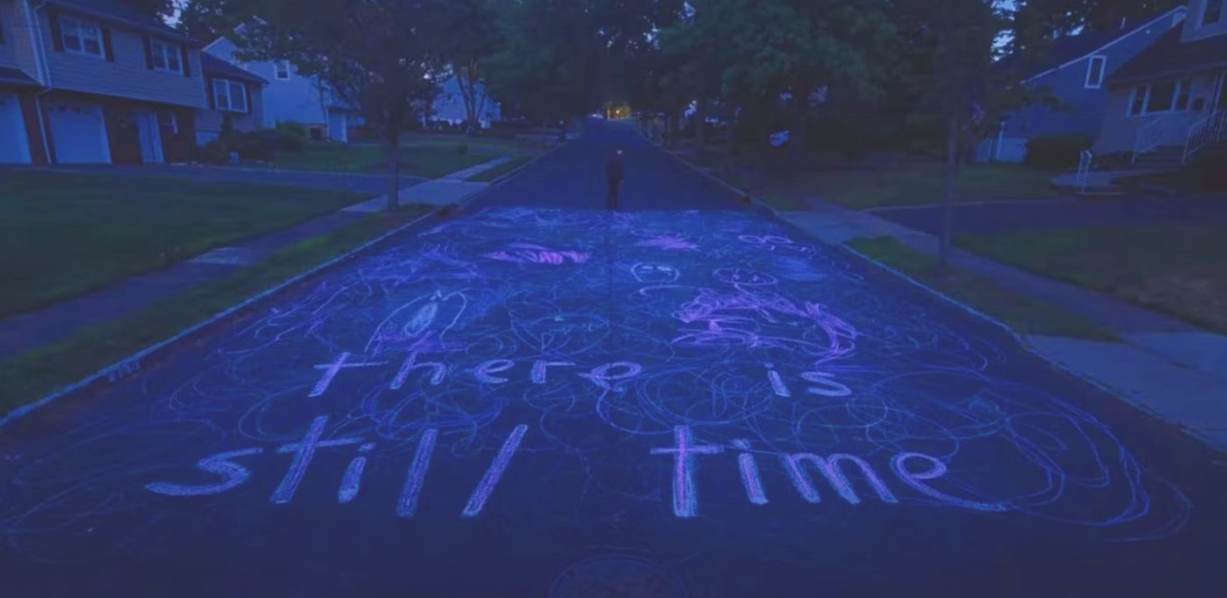
“There Is Still Time”
After all, we don’t make these movies about the elderly, trapped in a nursing home, having to roll themselves down a hallway desperately as Michael Myers lumbers in his Shatner mask, knife in hand. In fact, we often these days make the elderly the villains of these movies, a wrinkled parasite who views the youth as a lesser being they can harvest as a resource. They’ve had their time, and fuck them for wanting more, say X, Barbarian, Weapons, Don’t Breathe, The Substance, and Relic.
What if someone dies with decades left, though? All those things that we— I mean they—were planning go out. No college, no marriage, no self-discovery, no further phases. All just snuffed out in an instant; we see a kaleidoscope of possibility come jarringly to a close. For us, that teen represents the joy of youth, which is your whole future laid out before you, and whatever bugbear we’ve chosen to represent in prosthetics and kitchen knives has come to make sure you don’t get another day.
I think it’s why the horror genre took such commercial life once the category of “teenager” was established. For centuries, you moved directly from childhood to adulthood; you hit a point where you took whatever responsibilities were in front of you, away from the ownership of your parents and directly into ownership by your boss. But in the post–World War II prosperity, we no longer needed the child to directly start earning for the family. We gave them time in between to figure out what they could be. You could be a child trying out adulthood.
And from there, a new category of fear. A child dies, and they never got to live. An adult dies, leaving behind the life they had. But a teenager? A teenager—we got to see the beginnings of the life. People started to care deeply; things were forming; a world that could be would go away. We had countless songs in the early rock-and-roll days lamenting lost young loves who died in accidents and tragedies because, for the first time, there was a world to come, not a world that is or isn’t.
In other words, one of horror’s most animating impulses is that of losing the world that can be, of having potential snatched from our hands. But let’s be honest: most of us will likely not die young at the hands of goblins, ghouls, and zombies with no conscience.
We may fail to live, though.
“There Is Still Time”
Why does I Saw the TV Glow have the animating power it holds for its faithful? Why, despite hewing far away from the conventional trappings of the horror genre (minus a late-film sequence ripped from a 2 a.m. turn down the wrong corridor of creepypasta YouTube), is it so deeply terrifying to those who connect with it?
In the final 20 minutes of the movie, after our main character Owen (Justice Smith) finally leaves Maddy (Jack Haven) behind for good, we cut to years later, as he abandons his obsession with The Pink Opaque, the Buffy-esque show our two characters (Maddy especially) grow to believe they have some deeper connection with. Owen moves along, becomes a man, keeps a job, a house, a family he loves (“more than anything”—a line that Smith gives a pained twinge, as if Owen is convincing himself more than telling us).
And yet, he can’t convince himself that Maddy wasn’t right. That maybe they were both connected to this show; maybe she was Tara, and maybe he was Isabel. Even though he goes back to the show and sees it for what it maybe always was—a kids’ show shot on a budget of $5—the idea that there is something more in life has never left him.
We see repeated flashes of the moment he indulged the idea that Maddy was right. Where he put on the dress that Isabel wore, a sly smile to himself, Maddy’s jaw dropping as she saw… him. A moment all too familiar. It’s not something we ever see him do again, but it clearly rests deep in his brain, the memory of when this was a possibility.
To the point that it breaks him down. In the film’s most harrowing scene, an older Owen, wheezing and moving slowly through the same job he’s been working for almost 20 years, has a breakdown that only he seems to feel. He screams and cries and laments that he is dying. He begs those around him to see him, wondering why no one will help him.
And then, alone in the bathroom, he tears himself open to that other world. It rests him, and he returns. No happier, no less wheezing. But a brief thought of that other world allows him to live.
It’s an undeniably dark ending, an ending where Owen rests in all-too-familiar happy misery. He has what he’s supposed to want and yet, behind the eyes, rests nothing but pain and sorrow.
In other words, that animating impulse of horror—the death of possibility—has happened to Owen in a way far more realistic to us than so many other horrors. You may see the person you never loved, the job you never took, the chance you never had. You may see what you left behind; you may see what you never took. But what’s in this ending is that the death of our protagonist is the path not taken, and the only solace in the grinding misery of life is a brief remembrance of what might have been.
The memory of when you could have been Isabel.
“There Is Still Time”
But maybe this is all too personal for yours truly. To me, this movie is like a slasher where the ending is watching a video of you getting in the car and driving off as the killer lumbers up slowly, right as the car door closes.
I am transgender. Most of you reading this know this; some of you may find it a surprise; some of you may stumble and have no context. I lived 30 years as an Owen, one as something in between, and I have recently come fully into myself—who I am and what I want to be.
I watched this for the first time a week after I had come out to my wife. At that point, it made me sob deeply in a theater where I could feel most everyone around me bouncing off it. It was still so raw, so new. I was seeing someone put these emotions to film in a way no one had.
I watched this again two days ago, on the same day I began the process of HRT, on the day that I saw Abigail on a medical form for the first time. I still think it’s a masterpiece, but I was shocked by how different it felt. I remember every scene going on twice as long in the first watch, as if every scene wanted to twist and turn it in me as long as possible. I remember the ending washing over me like a wave, feeling like I was just barely above the water.
This time, I felt relief as if I was watching the bullet whizz by my head. I felt sympathy, knowing (as is so often joked) that estrogen could have saved her. And I felt what Jane Schoenbrun, a trans person themself, meant by
“There Is Still Time.”
My first watch, I felt relief knowing there was; I felt it talk directly to me. This time, I felt it talking to everyone.
There is still time. The death of possibility is terrifying. It animates so much. But it is also so much less permanent than any other in this film. You can still be who you are, and for the first time, I know that is true.
“There Is Still Time.”