The People's Joker, or Finding the Queer Self in Pop Culture
In September 1974, one of the most important modern works of fiction was quietly released in a small adult zine eloquently titled Grup. You very likely do not know its name, but you (if you are the kind of person reading me) very likely are familiar with the steady and pulsing ramifications of this work, entitled A Fragment Out of Time.
A Fragment Out of Time is the first piece of slash fiction published for public consumption, a 500-word story detailing an erotic encounter between Captain James Tiberius Kirk and Commander Spock. While works like this had been passed around privately among fandoms beforehand (for those curious, some of these early slash pairings included Holmes/Watson, Bruce Wayne/Dick Grayson, and Napoleon Solo/Illya Kuryakin), this work of Kirk/Spock fan fiction was distributed and read by the fandom public, away from the world of drawers and private circuit readings.
Now, it is important to note that this story was not written by a gay man, but it is what started to break a dam down in the fandom engagement of pop culture. Queer engagement could move towards no longer being a shameful secret, queer reading now a mode of engagement with these works. Not right away, of course; that would be silly.
But looking over the modern fandom landscape, it's hard to imagine this world without the gays. The fujoshi is the backbone of internet fandom; their desire to see two cute boys kiss can make or break almost anything. If the Mandate of Heaven switches from the MCU to the DCU, the course of fate may have been altered almost entirely by those who were done with Stucky and have moved on to an intense desire for sexual congress between David Corenswet's sunshiny Superman and Robert Pattinson's MCR Batman. Arcane as an entity propped up almost entirely by salivating lesbians genuinely excited to see two lesbians have actual sex (and not merely the Hays Code suggestion of such) in a mainstream work.
More importantly, for all the surface-level pleasures and fights, what matters here is that there is a space in this for queerness to exist in popular culture in a way there never was. But not through a more accepting world; sadly we are closer than we've ever been and still so far away.
Queerness in popular culture is so often not a blooming flower garden, but a single flower emerging through the cracks of the sidewalk. A place that it is not meant to grow and yet saying “fuck you” and doing so anyway. More than ever, there is space to remix and reinterpret these works through this lens, for these to become dominant interpretations that can be tattooed on the body, and to allow the conception of such works in a way that allows our stories to be told by us, rather than about us.
And as much as I would love to give you an insight into my own interpretation of these things, the building blocks that got me there (The Matrix, there done. More on that later), it has been in many ways already done through Vera Drew's rebellious love letter and fuck you to DC Comics and Alt-Comedy, The People's Joker.
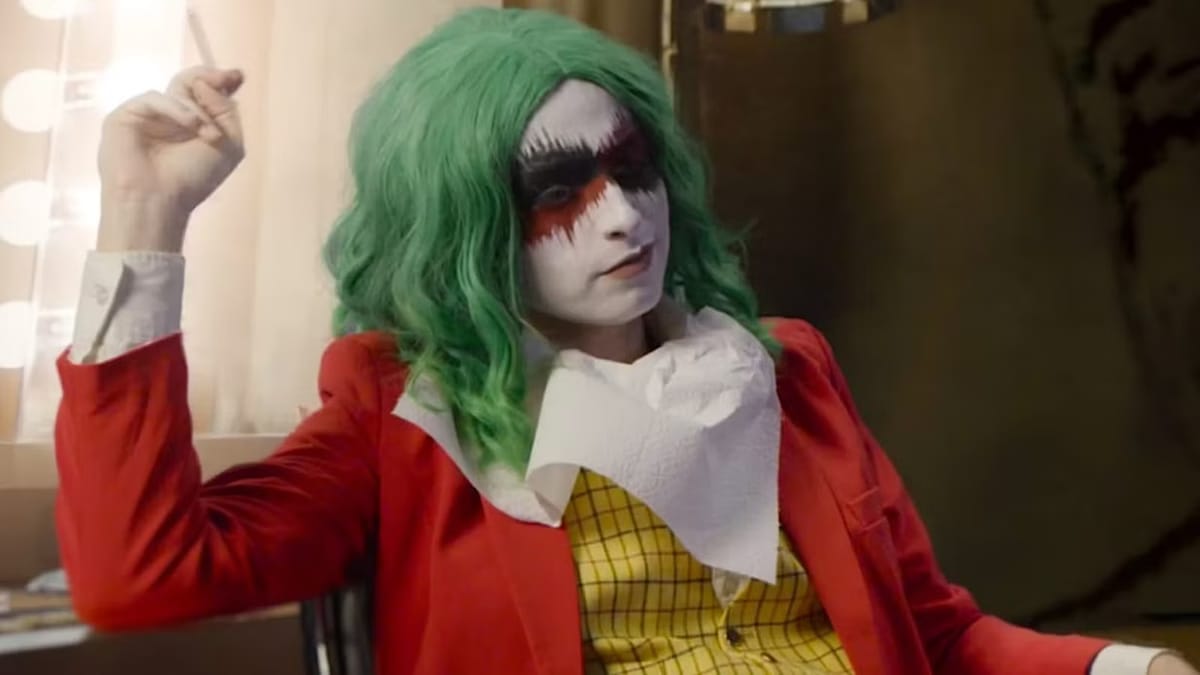
If you haven't heard of this one or seen it, completely understandable, as it very nearly didn't come out. The People's Joker depicts Joker the Harlequin (Vera Drew) and her journey of trans self-discovery, love, self-acceptance, and her battle with Batman (Phil Braun) and the forces of UCB and Lorne Michaels (Maria Bamford).
Now, a very important note about this film: it was made totally independently on a shoestring budget, a genuine mixed-media punk rock work. It was also made with a fuck lot of Warner Brothers IP and a fuck none of Warner Brothers’ legal permission. As much as parody law does protect the usage of these things in a genuinely transformative way, you still have to win that fight, and Warner Brothers was more than happy to try to fight a film that depicted their biggest money maker as a grooming closeted fascist.
(Yes, it was never officially confirmed that Warner Brothers Discovery sent the angry letter pressuring to pull the movie, but come on now.)
But it did come out and it's well worth your time, because I think few films understand how queerness is about finding the way you fit in a world that is not designed to fit you, how these institutions you love don't always necessarily love you back.
Something I know well because Vera Drew and I share deeply similar obsessions. My earliest known possession is a Batman cape. I've watched Saturday Night Live for two-thirds of my life now. I've listened to months of Comedy Bang! Bang! and have an extensive knowledge of the network spread of Mr. Show to the Upright Citizens Brigade (UCB) and the world of alt comedy performance and podcasting. Hell, I knew Vera Drew was an editor on the Comedy Bang! Bang! TV show, which is how this little crowdfunded movie has cameos from Scott Aukerman, Tim Heidecker, and Bob Odenkirk!
Comic books and comedy are very similar in that they are encyclopedias for the faithful. Endless information and data that can be matched and recalled, and also endlessly matchable. The People's Joker, in conglomerating these things, understands this, taking constituent parts and putting them back together to serve the narrative.
Mr. J (Kane Distler), Joker's emotionally manipulative trans boyfriend, is the peak of this fridge-magnet nature of this knowledge. Deadnamed Carrie Kelley (Frank Miller's girl Robin from The Dark Knight Returns), Mr. J is groomed by Batman into a sexual relationship after coming out and transitioning to Jason Todd (the second Robin, who famously dies and comes back angry and seeking revenge) and breaks away from the Bat to become a Joker (who looks suspiciously like Jared Leto's King Douchebag Joker from Suicide Squad).
And this is so much of finding that space for yourself within these works that I think I connect with about The People's Joker. No one piece of the original stories here specifically relates to the queer experience. But it is taking the world that is not shaped for you and finding the shape you fit by breaking it apart and building it back together. A new story, weaved out of pieces of the old, and putting enough of your own life to make part of the world as you see it. To me, that is queerness in art, understanding that you are taking what has come before you and more explicitly making it your own, showing why you connected with something that wasn't for you.
Because so little is. That's the other understanding The People's Joker has. Even when she is finally given her chance to host UCB Live (the show's very unsubtle SNL parody), it won't leave her deadname behind. The computer that allows her inside reminds Joker that these institutions will never truly accept her, just allow her there for the points.
And in a year where a trans woman writer got thrown under the bus by DC Comics and Saturday Night Live is still having Dave Chappelle host like he isn't on Team TERF and is more than happy to play around with the idea of men pretending to be women to get access to their spaces in a way often indistinguishable from the fever dreams that power bills around the country.
It's hard to remember that these institutions that I've loved my whole life don't necessarily love me back. They'll take my eyeballs and money, but they've done a lot of evil and they're more than fine to keep doing it.
And that is also queerness. The world is hostile to you. Maybe one day it won't be, but for now you have to spend a lot of time engaging with these institutions that you love and admire that aren't always going to return the favor. You have to assess jobs that might be ready to throw you under the bus; you have to have family that you know at any minute just won't be okay with things and cut you off.
And that's what this movie gets, especially in the final moments. Cropping up where you're supposed to doesn't mean it will last forever. It can be hard to even dream of a world where it's all perfect, but you know you can take the things you enjoy and have a few moments of happiness. You find those who love you and those who you love and give and care for them. You carve your space and you make a few for yourself. And you steel for the world ahead.