The Running Man, or Relevancy Isn't Relevant
It is 2025. That much we can agree on.
To get away from it all, I went to go see The Running Man.
43 years ago, Richard Bachman (far be it from me to deny anyone their preferred name) wrote a book about a futuristic game show called The Running Man, where average people are given the hope that, after surviving for 30 days being hunted by corporate raiders and their fellow countrymen, they can make enough money to make their way out of despair and poverty. His protagonist, Ben Richards, is a down-on-his-luck family man, blacklisted from employment and angry at the system, who goes on the show for a chance to save his child and takes it further than anyone has.
While essentially frightened of TV game shows and reality television in a way that seems positively quaint, he called a shot like Babe Ruth towards the edge of Yankee Stadium. And then 38 years ago, Arnold Schwarzenegger starred in a movie based on said book that threw out the everyman protagonist, lean and hungry, in exchange for a man who looked like he required more protein for breakfast than would be available in a collapsing America.
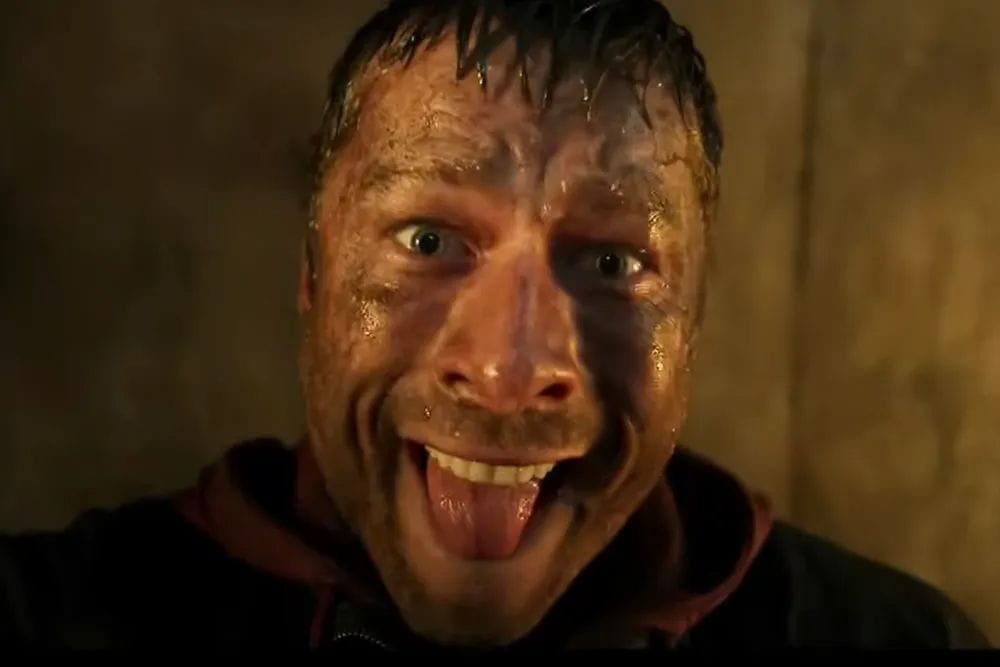
Everything, therefore, logically follows that Edgar Wright's readaptation of The Running Man, released in the original year the book was set, switching back to the wiry everyman version of Ben Richards (albeit with the face of Glenn Powell), and released coincidentally in a swirling vortex of political despair, should be ripe to speak to our moment and hit like a proverbial ton of bricks.
And yet, it is…
Fine.
Part of this fineness rests on Edgar Wright himself. For a certain generation of millennial film nerd, Edgar Wright's balletic, musical, frantic directorial style is as central to the idea of cinematic cool as Breathless was for the 90s Indie Brats. I remember the revelatory dance of cutting that is Hot Fuzz or Scott Pilgrim feeling like the first cinematic work of art that had been immersed in the same pop culture I was.
But that style was the style of a young man. It is the style of breathless excitement, of endless conversations about shot choices and record store flip-throughs, and the energy that comes with the disbelief that somehow you're being allowed to make a movie at all. It's a style of tribute and synthesis, a cinematic DJ bringing the house down at full volume.
As time comes, as it will for us all, it is increasingly clear that Edgar Wright is adrift without his youth, and he is unsure of the cinematic blood that pumps underneath that. While I cannot follow those who said Baby Driver is the beginning of this, it is undeniable that Last Night in Soho showed the flaw of the film nerd style.
Namely, of course, that nerd is a pejorative as well as a descriptor. Last Night in Soho wished to pay tribute to the Giallo masters, but to be frank and R-rated, Edgar Wright is not a pervert; he does not fuck like that. And in The Running Man, it is clear that he wants to pay tribute to the masters of 80s action films that deeply underpin his style, but slowed down, it's clear he's not that kind of freak; he's just not that cool.
This is a Verhoeven picture without Verhoeven's off-kilter eye towards America and his deeply held anti-fascist beliefs; De Palma without his perversions and his willingness to indulge them. It's the conversation from 40-Year-Old Virgin about the bags of sand; Edgar just simply does not have the substance if he's going to stop having the style, so he needs to find something soon.
And that loss of style is sorely felt. An Edgar Wright movie used to move. These were not boring affairs; you were coursing and racing through the story, the action feeling like a shot of adrenaline to the heart. Any glimmers we get of that (especially in the first hour) are quickly tamped down by a shockingly slack pacing. This movie is long and feels longer. By the time we are at our disastrous third act, I was shocked that it was still the same day I had begun watching the movie.
So, what is left for a picture that is so anonymously directed at the camera?
Alright, I'll give it this. There is almost no actor in this movie who is at fault here, so hey, credit to Wright there. Everyone is giving their level best, and many even going further than that, making a meal out of the 5 minutes they're given in a movie that has more than enough time in it to give them more.
Michael Cera's late-game play as a revolutionary is a reminder of the weird charisma that has always held firm in the center of his awkward persona. Colman Domingo and Josh Brolin both devour, with full jaws, the role of the drivers of The Running Man's engine. And Katy O'Brian continues to stun in "not enough" roles; the person who finally gives her something substantive to do is going to look like an absolute genius, and same to Jayme Lawson, who plays Glenn Powell's wife.
Unfortunately, it is maybe Glenn Powell who is the closest to causing this movie problems. Happy to report that he is miles better than Schwarzenegger by virtue of playing a character. But he still feels a hair away from elevating this movie—the mark of a movie star. To give credit to the friend I saw this with, he feels as though he is shooting for an angry George Clooney, occasional bursts of anger sailing over a collected and thoughtful, level voice.
But what Glenn needs to be is his adopted father, Tom Cruise. A few Ethan Hunt-esque line deliveries could have brought this to the next level, a man you truly believe now has a course of madness underneath the burn-out and the rage. As is, there's too much everyman and not enough pushed to the edge.
(Spoilers here, but if you're trying to avoid: basically the third act is a disaster that tries far too hard to uplift the audience in a story that needs to end in shock and despair, and frankly, it's cowardly. But also, this bit is why I chose the headline, so maybe read anyway—were you really gonna go see this before it was on streaming?)
And even the best acting can't save a story that grasps desperately at the current moment and loses its grip.
From a story perspective, Wright's Running Man is deeply and consistently faithful to the original novel for the first 3.75/4 of its running time. Yes, even the storyline with his video messages being altered that feels like anti-AI was in the novel.
Then, of course, it needs to commit to the classic bleak 70s sci-fi (I know it was written in the 80s, just roll with me here) ending of the novel, wherein our protagonist 9/11s the Network's building in a remote-piloted plane, killing himself and our villain in a fiery act of desperation and revenge.
The original movie had Schwarzenegger kill our villain with a rocket sled and then kiss the girl, and everyone cheered around him. Ya know, like an 80s action movie.
So I was genuinely impressed that, despite the fairly boring action of the final 20 minutes, the movie shoots down the aforementioned remote-piloted plane over the city, making this a stunningly bleak movie about the difficulty of fighting the system.
It keeps, however, going.
This act spurs a revolutionary movement that finally brings down the Network. And of course, Ben Richards is alive. He gets to take the final act and shoot the CEO of the Network in the head on the very stage that tortured him.
Yes, it can feel cathartic in this moment to see success like this. But beyond the narrative problems here (grabbing the fairly bleak and difficult narrative so far and wrenching it in the exact opposite direction is tonal whiplash so wild that I may have a lawsuit on my hands), it's cowardly.
Turning your story into a more explicitly joyous metaphor for the current moment makes it speak past the feelings. I am a believer in negative art. It is cathartic to know that someone is feeling what you are feeling, that anger can be a gift in this moment, and that there's something to the fact that not everyone is going to rise up in the face of oppression, but goddammit, you're going to. That is what is so perfect about the original ending, and going away from it makes this film less relevant to a moment of despair, not more.
It sounds like a bad time was had with the film, and it wasn't. Generally, this was, as stated, fine. But it sticks in my craw because it represents so many frustrating failures: a director who's lost his step adapting a story that people still aren't getting right in a moment where both could be doing so much better.
It sucks when a kid is bombing a class because they're just not there with the material. But it feels even worse when you know they could be doing so much better, and they're just not.