Wake Up Dead Man, or Why We Believe
The writer W. H. Auden, in his essay The Guilty Vicarage, wrote that the fundamental "phantasy" of the detective story is being "restored to the Garden of Eden," "where [we] may know love as love and not as the law." The detective's job is to "restore the state of grace" or to repair the sin visited onto the world of our novel, always by murder ("negative creation"), where the murderer claims "the right to be omnipotent" and to break the order of God.
Important here is that our fantasy of the Detective is separate from the story of the Policeman. Even if the Detective is of the Police, he is not interested in the base world of the guilty and the innocent. He is searching for the Higher Truth, not just Who, but Why, and How Do We Go Back To Before. The Detective, in this reckoning of the detective story, is more than a simple deducer of fact and fiction, but a visitor to our world who is trying to wash away our sins, Jesus Christ in a trench coat with a notebook.
Why does this appeal? Why do Sherlock and Dale Cooper and Hercule Poirot and Benoit Blanc stick so deeply in the craw of our society? Because we want to believe in that higher power's—their ability to do something while we're here. We want someone to impart grace onto our cruel world and tell us that the murdered has justice in this world, not simply in Heaven beyond. We want healing and care, not simply something to believe in.
That is the idea that lies at the core of Wake Up Dead Man, Rian Johnson's third entry in the Knives Out series. Shifting away from the breezy Twitter-feed social satire of Glass Onion, Wake Up Dead Man injects a core of gothic horror and genuinely reflective emotion into the formula to create the series' most moving and thoughtful entry yet.
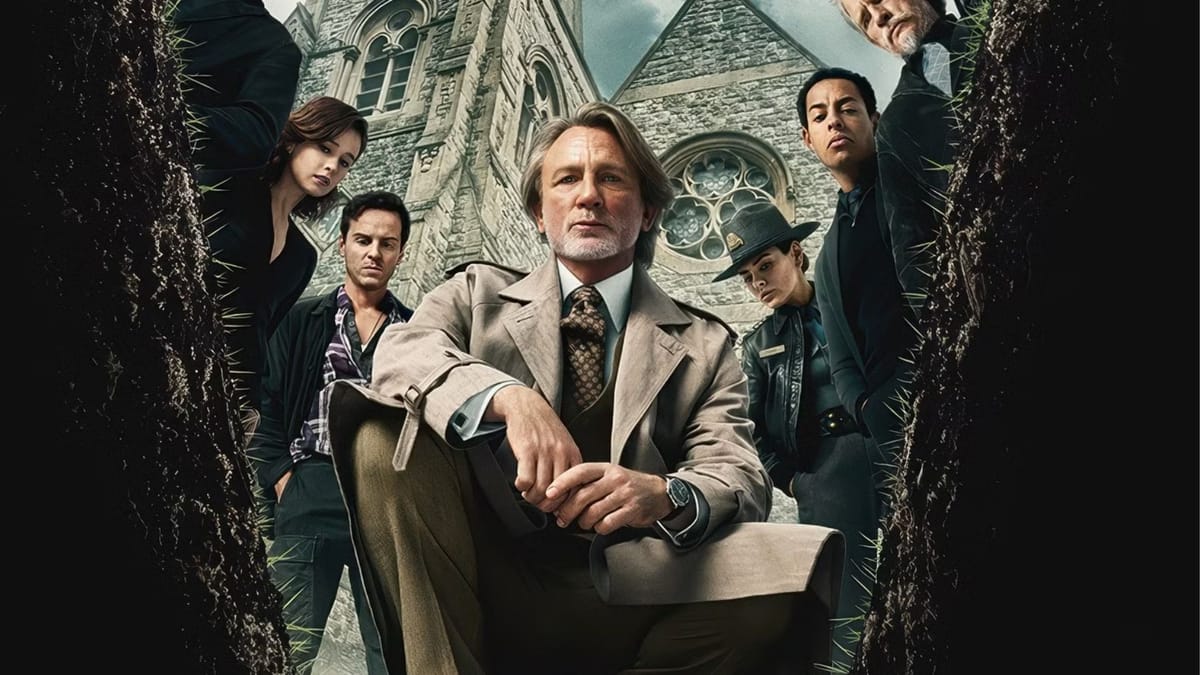
All the familiar pleasures are here. Writer-Director Rian Johnson pops Detective Benoit Blanc (Daniel Craig) into yet another murder alongside a plucky young sidekick involved in the murder, played by a plucky young actor, this time Rev. Jud Duplenticy (Josh O’Connor), a young priest sent to a small town to assist a congregation led by the terrifying and charismatic Msgr. Jefferson Wicks (Josh Brolin).
When there, Blanc encounters a cast of veteran actors (Glenn Close, Thomas Haden Church), folks stuck in the MCU who welcome an opportunity to do some real acting (Jeremy Renner), great TV actors who never quite got their movie due (Andrew Scott, Kerry Washington), and of course a couple of great young stars getting a chance to really show off in the kind of picture they don't make anymore (Cailee Spaeny, Daryl McCormack), while fending off local police (Mila Kunis) and trying to get to the truth at the core of the murder, one as simple as it seems, yet more complex than you could ever imagine.
I'm writing this 8 days before the film hits Netflix streaming, so I'll avoid digging too deep into the nuts and bolts of it all, but I will only note that more than the previous two, the twists and turns of this one are genuinely surprising. The more overtly foreboding atmosphere of Wake Up Dead Man keeps you just off-balance enough to believe anything put in front of you. So for those who felt the "glass onion" was a little too transparent, give this one a shot.
The more traditional review pieces of this one feel a little superfluous. I adore the Knives Out pictures in many ways because they show the merits of formula. It's a great cast of top-tier actors all bouncing and playing off each other in the joys that only come when you put a bunch of human beings in a room rather than in a green screen. It's a confident and steady hand at the directorial wheel, making sure that, despite being the longest entry so far and even having to putter just a little in the middle, this thing crackles and flies by with the compelling pulse of a good paperback novel. And, my god, it is lovely to have a major movie series that actually engages with the real world as it exists, not just cell phones, but in a landscape where we've all had our brains altered by social media feeds and clout.
If anything needs to be said, it is the degree to which Wake Up Dead Man takes the familiar pleasures and tightens all the bolts. The social satire is tuned up a little, getting away from the at-times eye-rollingly obvious stand-ins of Glass Onion to a deeper look at our addiction to powerful men and the hate they spread. The actors all gel a little better this time, and Josh O’Connor, in particular, proves why he is growing as one of our finest young actors, imparting the rough-and-tumble Jud with a heart overflowing and breaking from love for his fellow man. The film simply looks better, cinematographer Steve Yedlin deserving praise in particular for playing the lighting in this film like a violin, shooting a film both gothic and gorgeous (coincidentally, “gothic and gorgeous” is on my dating profile. Ladies.)
So what I do really want to zoom in on in this film is that, past any other film in the Knives Out trilogy, this is a film of feeling. Returning to our beginning, the figure of the detective is this belief in the idea that God is an interventionist God, that He is able to come in and fix things and set truth and justice on the right path even if we cannot.
It is very clear that that is the God that our sidekick Jud Duplenticy believes in, breaking from those around him in the town who believe in the hate and vengeance of God, as preached to them by the fiery Msgr. Wicks. Jud believes in the God of Love. And even more than Marta (Ana de Armas) of Knives Out or Helen of Glass Onion (Janelle Monáe), Jud believes in the idea that Blanc can set things right, and the challenge to his faith is the idea that what if he cannot. Blanc has never failed to solve a case, but what if he doesn't this time?
Yet, faith here is not in the works, but in the love that we show others around us. In a key scene of the film, Jud places a phone call to a local townsperson, in the hopes of moving the case forward and getting a little information. He doesn't get what he needs, but the townsperson breaks down, sobbing, and vents to him about these things going wrong that she hasn't been able to visit upon anyone else.
Jud is at the end of his rope. Jud is exasperated. And yet. He prays with her all through the night. He shows her the only love that he can in that moment, recognizing he has a higher calling—a higher belief—and that he owes her the love of being there for her.
This is why Wake Up Dead Man is the most successful of these Knives Out movies. Yes, in each of these, Blanc has set the world right, restored the Garden of Eden that the detective is responsible for. But here, Rian Johnson shows the core of the belief behind that, shows why we want that world restored. His social satire means so much more because we see why he's fighting against the things he's making fun of, what he doesn't respect about it.
To quote an earlier film of his, "we're going to win this war not by fighting what we hate, but saving what we love!"